Why You’re Stuck in Reactive Maintenance — and How to Break the Cycle for Good

Find out why you’re stuck in a never-ending reactive maintenance cycle and what you can do to begin the shift to a more proactive maintenance strategy.

ServiceChannel
Even if you’ve never heard the term “reactive maintenance cycle” before, you’re likely familiar with this vicious cycle. A reactive maintenance strategy involves waiting until a failure occurs before performing maintenance on assets.
Due to the delay, the failure typically results in a breakdown, followed by unplanned downtime. Because when production or work time is lost, your maintenance team must scramble to perform emergency repairs.
As a result, there is not enough time to perform preventive maintenance. The lack of planned maintenance means you once again wait until a breakdown to complete maintenance, and the cycle starts again.
Although this cycle can seem endless, it is possible to reinvent reactive maintenance environments, reduce maintenance costs, and simplify operations for your maintenance team. Determining why you’re stuck in a reactive maintenance cycle is an important first step.
Many factors can create purely reactive maintenance environments, including asset history gaps, work order backlog, inconsistent triage after failures and breakdowns, and a lack of outcome tracking. Similarly, solutions to shift your operations from breakdown maintenance to a proactive, preventive maintenance strategy include standardizing dispatch, prioritizing preventive maintenance compliance, leveraging provider analytics, and adopting a more proactive approach.
In this guide, you’ll learn more about the causes of reactive maintenance cycles, how to determine if you’re stuck in one, and what you can do to break out.
Key Takeaways
- Reactive maintenance cycles cause maintenance teams to constantly fight fires, preventing them from getting ahead with preventive maintenance.
- Repeat service on the same asset, unclear dispatch instructions, and constant firefighting are warning signs that you’re in a reactive maintenance cycle.
- Causes of strictly reactive maintenance cultures include incomplete asset history, preventive maintenance slippage, manual work orders, and a lack of first-time fix tracking.
- Improvements in asset management, work order automation, the implementation of provider scorecards, and stricter predictive and preventive maintenance discipline are among the top fixes for an overlay reactive maintenance strategy.
What Are the Warning Signs You’re Stuck in a Reactive Maintenance Cycle?
Before you can begin shifting a reactive maintenance culture, you need to recognize the symptoms, such as repeated service on the same asset, high rates of emergency repairs, long lead times, and budget volatility. Here’s a look at some tell-tale warning signs that you’re stuck in the never-ending reactive cycle:
- You’re Constantly Dealing With Trouble-Making Assets: Do you often find yourself saying “Again?” when you receive an alert that a specific asset has failed again? Repeat repairs and frequent failures on critical assets usually signal that a maintenance plan is too overloaded with reactive tasks to get ahead.
- Emergencies Make Up the Bulk of Your Labor Hours: A high ratio of emergency to planned maintenance usually signals that your program is overly reactive. The reactive-heavy maintenance task mix suggests your team spends most of their days firefighting rather than performing activities that reduce failures.
- Everything Is Behind Schedule All the Time: Repair times that consistently run long often signal that repairs are overly complex due to major breakdowns rather than minor issues. Similarly, work order backlogs often indicate that your team can’t keep up due to constant emergencies.
- You Always Run Over Budget: Reactive strategies lead to budget volatility. Frequent deviations from service provider Not-to-Exceed (NTE) limits and rising emergency repair expenses indicate that you often wait until a breakdown occurs before performing service.
Root Causes of an Overly Reactive Approach (And How to Fix Them)
Performing a root cause analysis can help your team determine the exact origins of your reactive loop. However, the following are some of the most common culprits when maintenance cultures are too reactive, along with steps to address them:
- Incomplete Asset History: A lack of asset history makes it impossible for your team to identify lifecycle patterns to predict failures before they occur. Beginning to gather structured maintenance data with standardized asset identifiers and outcome logging can create the foundation for a more proactive program.
- PM Schedule Slippage: Not keeping up with preventive service tasks leads to blind spots, leading to risks of failure, safety issues, and service provider noncompliance going undetected. Prioritizing audit compliance and your PM program can help you take a more proactive approach.
- No First-Time Fix Tracking: If you don’t track how often service providers make the fix on the first try, you have no way of knowing if someone’s underperformance is responsible for your frequent breakdowns. Increased accountability, such as requiring outcome codes and photographs upon work completion, can support a more proactive maintenance program.
- Manual Work Order Processes: Manual systems tend to be slow and inconsistent compared to automated processes. Deploy maintenance software so that you can establish clear, consistent rules for triaging and dispatching.
What “Good” Looks Like
Breaking out of a reactive rut will dramatically transform your maintenance operations across locations. Outside the cycle, you can expect:
- Clear visibility into asset service history and current status
- Standardized rules for triaging issues dispatching service providers
- Total PM compliance with all planned work occurring on schedule
- Predictable budget due to the emphasis on scheduled maintenance
- Reduced downtime, thanks to a more proactive approach
- More efficient and consistent maintenance operations, evidenced by PM compliance rates, total downtime hours, and other key performance indicators (KPIs)
- Reduced risks with an emphasis on safety and regulatory compliance
Shift from Reactive to Repeatable
Now that you know how to identify a proactive maintenance culture, it’s time to figure out how to get there. Adhering to your PM schedule closely is an important first step. As you implement strategic changes, you can also use predictive maintenance tools, such as Internet of Things (IoT) sensors, to anticipate failures. You’ll also want to track KPIs to monitor your progress over time.
Make Strategic Changes
To start the shift, consider the following strategic changes:
- Create dispatch rules that clearly define what is an emergency, which service provider gets called for which problems, and what information you include on every work order
- Systematically collect and store accurate information about all your assets and assign each one a unique identifier for tracking
- Begin evaluating and monitoring service provider performance with scorecards
- Perform a root cause analysis to determine the underlying cause of repeat failures for your most critical assets
Track the Right KPIs
Monitor where you are in the shift by tracking the following KPIs:
- Percentage of preventive vs. reactive work orders
- First-time fix rate
- Repair vs. replace decisions
- Mean time to repair (MTTR)
How ServiceChannel Supports a Proactive Shift
ServiceChannel supports your proactive shift so that you can continue to make continuous improvements to maintenance management and strive for optimized operational excellence. Our computerized maintenance management (CMMS) software helps you identify the root causes of reactive cycles and break free of them once and for all. Here are some features that can help you reduce repeat failures and transition to a more predictive and preventive maintenance program.
Asset History
Without an adequate asset history, implementing a preventive and predictive maintenance strategy is virtually impossible. ServiceChannel strengthens your asset management efforts, providing a single source of truth for all historical data. As a result, your entire team can access maintenance histories over the entirety of asset lifespans, and you can begin to identify predictive maintenance opportunities.
Work Order Automation
Paper work orders can lead to errors and oversights and delays in dispatching when equipment fails. Our CMMS eliminates these issues through work order automation. Automated dispatch rules integrated with your SLAs and standardized triage rules increase your agility, allowing you to respond more quickly to equipment failures and ensuring that work orders don’t fall through the cracks. Plus, our mobile tools enable technicians to update service requests in the field, limiting costly disruptions.
Provider Performance Analytics
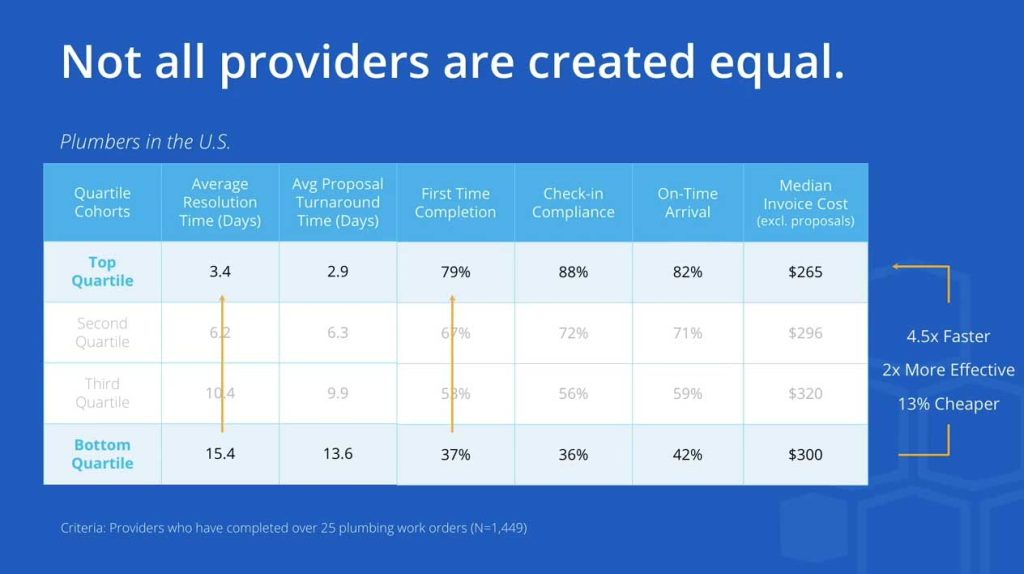
If you’re not regularly evaluating service providers, you have no way of knowing what you’re getting for your maintenance costs. Our CMMS makes assessing service provider performance simpler. With provider scorecards, you can easily spot areas of improvement and track changes in performance over time. Plus, our powerful analytical tools let you keep tabs on crucial KPIs, such as the mean time to repair critical assets and the first-time fix rate for all maintenance tasks a service provider performs.
Maintenance Scheduling
It can be difficult to initiate planned maintenance when you’ve been busy with emergency repairs. However, our maintenance software makes preventive maintenance more accessible. Automated scheduling tools ensure that preventive work takes place well before urgent repairs are necessary, lowering the likelihood of repeat failures.
Plus, built-in compliance monitoring lets you more closely track any piece of equipment that carries an elevated safety risk. And with our AI-enabled tools, you gain a solid foundation for a predictive maintenance program. Our advanced technology uses current sensor data and historical information about when equipment fails to automatically schedule service so that you can take a more proactive approach to maintenance.
Thanks to the total visibility, increased agility, and performance-boosting features, our maintenance software helps transform reactive maintenance environments. With ServiceChannel software, you can benefit from fewer emergencies, faster fixes, lower-cost variances, reduced total maintenance spend, and increased accountability for service providers.
Turning It Around: A Real-World Example
To understand the impact of a proactive shift, consider the hypothetical example of Brand X. Its incomplete asset data and inconsistent preventive service discipline led to ongoing HVAC issues that quietly drove nearly 30% of annual repair spend. Equipment failures felt random, and service providers often had to come twice to address the same issue.
To get out of their run-to-failure rut, Brand X centralized asset histories and established a maintenance schedule. It also began using provider scorecards to track first-time fix rates. Within a year, repeat visits had roughly halved, and unplanned downtime dropped across key locations. The shift didn’t happen overnight, but with completely visible data, steady planned maintenance, and accountable providers, Brand X gradually moved further and further away from reactive mode and into predictable, preventive operations.
Break the Reactive Maintenance Cycle
Having the freedom to focus on preventing failures and making a more proactive maintenance plan for your facilities is possible. Take the first steps toward breaking the endless reactive cycle by speaking with an expert to improve first-time fixes and reduce emergency work. Book your demo today.
Reactive Maintenance Culture FAQs
Learn more about reactive maintenance programs and their fixes by reviewing the answers to these frequently asked questions.
Poor asset history recordkeeping, a lack of attention to preventive maintenance, a reliance on manual work orders, and a failure to track first-time fixes are among the most common causes of a reactive environment in facilities. To succeed, proactive maintenance strategies require robust asset data, clear tracking of key performance indicators, and a commitment to reducing equipment failure through routine maintenance. In addition, manual work orders can lead to oversights and inefficiencies, resulting in missed maintenance opportunities and increasing the risk of equipment failure.
To move from reactive to proactive maintenance without blowing the maintenance budget, start small. Identify your top 10 most critical assets and begin employing a preventive maintenance strategy with them. In the meantime, start tracking your maintenance data more closely to support a transition to predictive maintenance.
Metrics that demonstrate you’re out of the vicious reactive maintenance cycle include the percentage of preventive maintenance vs. reactive maintenance, the first-time fix rate, repair vs. replace decisions, and MTTR. Maintenance software, such as ServiceChannel, can help you closely track critical KPIs to optimize maintenance activities and promote optimal performance across all locations.