
ServiceChannel
Modified on
July 23, 2026
Table of Contents
Learn how AI supports facilities teams and providers by reducing busywork, surfacing insights, and helping people make better decisions.
AI can help facilities teams and providers move faster, spot patterns, and reduce busywork. But for the best results, human judgement is more important than ever.
Facilities management has always been a people-driven operation. Behind every completed repair, approved proposal, provider relationship, and maintenance decision is someone making a judgment call about what matters most.
That won’t change with AI.
What will change is how much support facilities teams, operations teams, and service providers have when making those decisions. AI can summarize information faster, identify patterns across large datasets, flag potential issues earlier, and reduce the manual work that slows everyone down. But it doesn’t replace the experience required to understand a trade-specific issue, weigh cost against customer impact, or manage a provider relationship with the right balance of accountability and partnership.
The next era of facilities management will be defined by high-performing teams that use AI to apply their expertise faster, more consistently, and with better context.
AI is strongest when it supports human judgment
The best use of AI in facilities management isn’t to hand over every decision to a system. It’s to help people get the context they need, faster.
Facilities teams already manage a constant flow of service requests, open work orders, provider notes, asset histories, proposals, invoices, budget reports, and urgent escalations. The challenge is having enough time to interpret large amounts of data and acting on it before problems get worse.
5 Ways Data-Centric AI Is Leveling Up Facilities Teams
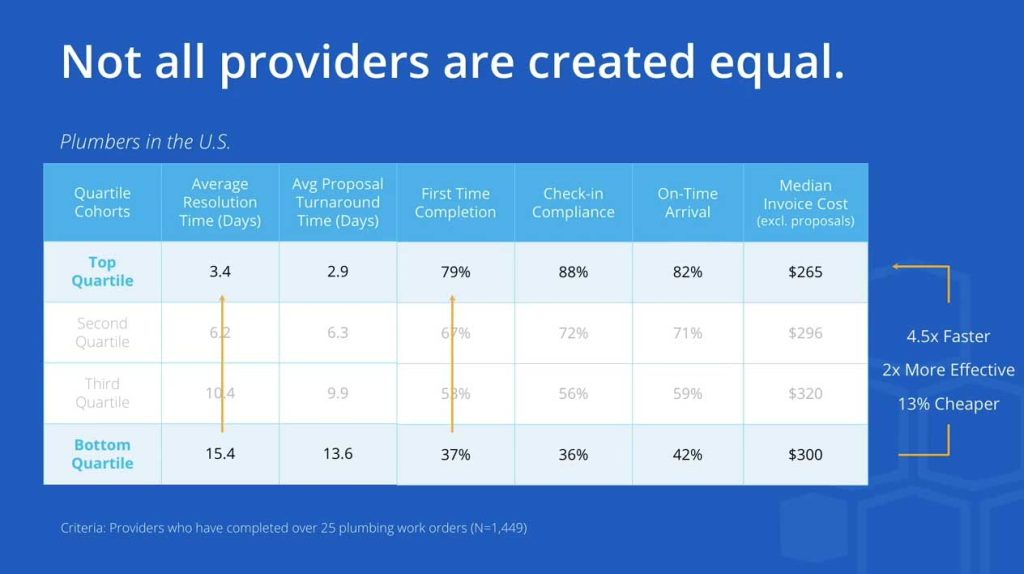
AI helps by turning operational activity into high-value signals that inform smarter decisions. It can recognize when a work order is missing information that requires a follow-up, flag a recurring asset issue that deserves deeper review, or show when repair costs start to exceed what’s reasonable. It can also help identify provider patterns that may affect speed, quality, or cost, such as late arrivals, missed check-ins, repeat visits, long resolution times, incomplete notes, frequent quote revisions, unusually high invoice amounts, or performance differences by trade, region, or location type.
AI provides the context that gives people a better starting point. Instead of asking, “Where do I begin?” teams can ask more strategic questions like:
- “Does this recommendation make sense?”
- “What context should we consider?”
- “How will this decision affect the location, budget, provider relationship, and customer experience?”
Trade expertise and operational context still matter
Facilities work is practical, technical, and highly dependent on context. A service request may look simple on the surface, but the right decision often depends on trade experience and expertise. An HVAC issue, for example, can involve asset age, weather patterns, refrigerant requirements, customer comfort, energy use, and long-term replacement planning. A refrigeration issue can affect product loss, food safety, and revenue. A plumbing issue can range from a minor inconvenience to an urgent operational disruption. Electrical and lighting decisions can affect safety, brand standards, and the experience customers and employees have inside the space.
“The real value comes from learning over time. When AI can analyze years of facilities workflows, it starts identifying patterns that help teams make better operational decisions.”
Zac Wolf
Senior VP of Product at ServiceChannel
AI can help identify patterns across issues both within the business and throughout the industry, but trade expertise helps interpret what those patterns mean in the real world. If AI shows that an asset has required multiple repairs in a short period of time, a person with trade knowledge can help determine whether the issue is related to normal wear, improper installation, poor maintenance, environmental conditions, provider quality, or a larger replacement decision.
Operational context matters just as much. The urgency of a repair depends on where and when the problem happens. A flickering light in a back-office hallway or a slow drain in a low-traffic restroom can usually wait for the next scheduled visit. But a walk-in cooler losing temperature at a restaurant, an HVAC failure at a clinic during a heat wave, or a refrigeration unit going down in a grocery aisle needs immediate attention. Every hour of downtime risks product loss, customer comfort, safety, or lost revenue. A temporary fix may be reasonable when a full replacement is already planned, but risky if the asset supports a critical customer-facing experience. A lower-cost provider may look like the better option until response time, first-time completion, and repeat visit history are considered.
This is where AI and human decision-making work great together. AI can surface the facts, patterns, and likely risks. People weigh those inputs against business priorities, customer expectations, staffing realities, budgets, and provider relationships.
Providers benefit from better AI, too
- Facilities performance depends on a symbiotic relationship between facilities teams and service providers: Teams need providers who can respond quickly, communicate clearly, and complete work correctly.
- Providers need accurate information, clear expectations, and efficient workflows so they can deliver that level of service.
AI can help both sides, starting with better work orders. When requests include the right location details, asset information, issue description, photos, priority level, and service history, providers can arrive more prepared and resolve issues with less back-and-forth. AI can help identify what information is needed up front, guide a more complete intake, and reduce the ambiguity that leads to delays or repeat visits.
“One of the advantages of having a large facilities dataset is that you can see what information typically leads to successful repairs. AI can use that history to guide better service requests from the start.”
Zac Wolf
Senior VP of Product at ServiceChannel
After a work order is created, AI can also help providers and facilities teams stay aligned by surfacing next steps, summarizing context, and highlighting urgent actions. That doesn’t remove provider expertise from the process. It gives providers stronger context so they can apply their expertise more effectively.
When facilities teams and providers are working from clearer information, fixes happen faster with less back-and-forth. Each successful job strengthens the partnership that makes the next one go even better.
The next era of facilities performance is human and AI working together
AI will continue to help teams move faster, spot patterns earlier, and reduce the manual effort required to manage complex operations across many locations. But the future of facilities performance won’t be defined by AI alone. It will depend on the people who know how to apply AI in context:
- Facilities leaders using it as a decision-support tool
- Providers pairing better information with skilled service
- Operations leaders weighing how each decision affects customers, employees, brand standards, and revenue
That’s why AI is most useful when it’s embedded in the workflows where facilities work already happens. When intelligence lives inside work order lists, details pages, dashboards, reporting tools, and mobile experiences, teams can get the context they need in the moment instead of stopping work to search for answers somewhere else.
ServiceChannel AI puts that principle into practice by bringing intelligence into the workflows facilities teams and providers use every day. Backed by the largest facilities dataset in the industry, built from 300 million work orders over nearly three decades, it helps turn real operational activity into clearer context and more actionable guidance.
That partnership is the real value. AI can surface what’s happening and recommend what to do next, while people use that context to protect the customer experience, control costs, strengthen provider relationships, and keep every location running at its best.
Learn how ServiceChannel AI helps facilities teams and providers turn real operational data into faster decisions and stronger outcomes.